Charles Mackay
The Wisdom of CrowdsCharles Mackay was a Scottish journalist best known here as the author of the 1841 book Extraordinary Popular Delusions and the Madness of Crowds. His account of mass manias supplied a memorable counterpoint to the argument that crowds can be wise: where the book finds value in combining independent judgments, Mackay saw collective life as a descent into shared irrationality.
Journalist and Chronicler of Manias
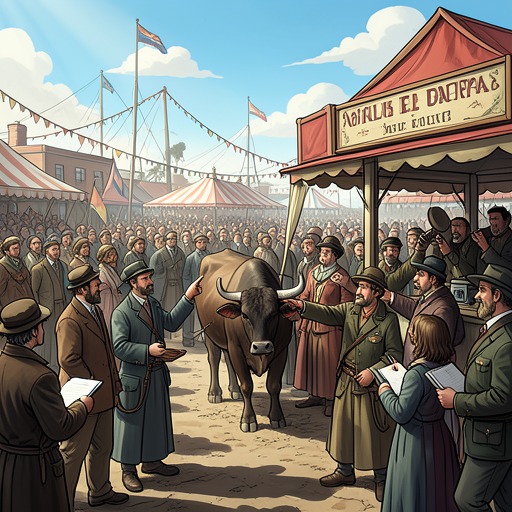
In 1841, Mackay published Extraordinary Popular Delusions and the Madness of Crowds, a chronicle of mass manias and collective follies. The book’s title pays homage to his work, establishing him not merely as a historical reference but as the representative voice of a long-standing belief that crowds are dangerous guides to judgment.
That belief was broader than a warning about spectacular episodes of mass enthusiasm. The book presents Mackay as part of a popular tradition in which groups are presumed to make people either foolish or irrational. His account gave that suspicion an influential literary form: collective behavior, in this view, is not a source of wisdom but a setting where judgment breaks down.
A Theory of Collective Madness
Mackay argued that crowds were neither wise nor even reasonable, and that collective judgments tended toward extremes. He described people as thinking in herds, becoming mad in herds, and recovering their senses only slowly, one at a time. The contrast makes the crowd’s errors appear rapid and shared, while recovery is gradual and individual.
His position belonged to a wider critique of collective judgment. Bernard Baruch described an individual as tolerably sensible who became a blockhead as a crowd member; Henry David Thoreau argued that the mass fell below its best member and toward its lowest. Friedrich Nietzsche characterized madness as exceptional among individuals but typical of groups, while Thomas Carlyle rejected the idea of collective wisdom emerging from individual ignorance. These parallel formulations situate Mackay’s view within a tradition that treats the group as a force that degrades, rather than aggregates, individual judgment.
The Book’s Counterargument
The book places Mackay’s skepticism against its central claim that people should stop chasing a supposed expert and ask the crowd instead. This does not mean that the crowd excludes experts: it includes them alongside everyone else. The contrast is between selecting a few prominent authorities and allowing a broader body of judgments to contribute to an answer.
Mackay’s work therefore functions as an intellectual foil. Its account of collective folly names a real danger in group behavior, but the book contests the assumption that crowds are invariably irrational. The disagreement is about what collective judgment can do: Mackay sees shared opinion as a route to madness, while the book argues that under the right conditions a crowd can know more than the individuals who compose it.